| T A N K S | C A R R I E R S | G U N S | A R M O U R E D C A R S |
Onwards to Berlin
We then headed for Berlin using the northern most corridor (Autobahn), driving right past Marienborn on the way. In Berlin we met up with Hermann and Helga who were our hosts for our stay in Berlin. Hermann had been conscripted into the Wehrmacht on his 18th birthday in July of 1944 and trained as a Tiger I Fahrer (driver), he later on also drove King Tigers, but spent most of his time as a technical officer (not rank: job title). He surrendered with his unit to the Americans in Austria, but was later handed over to the Russians with 500 of his unit (Eisenhower assured them in person that they would not be handed to the Russians). He then spent 5 years in the Yalta region 'breaking rocks'. He is one of the lucky ones, he was sent home.
First stop of military interest was Cecilienhof Palace, know to most of us as "Potsdam", this is where the famous conference with Churchill, Stalin and Truman took place. Potsdam is actually the name of the suburb.
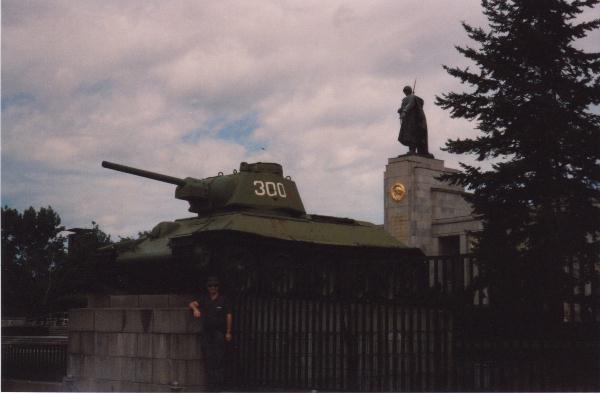
The Soviet War Memorial
Right in the centre of Berlin, just near the Brandenburg Tor (Gate) is this memorial. It has 2 x T-34 tanks and field guns. The tanks sport the usual mixture of road wheel variants which suggest they are genuine veterans rather than post-war ring ins.
Light conditions were not good, so the photo is dark.
|
|
East Berlin
This is the statue of Marx and Engel, the fathers of communism/socialism. It still stands, surprisingly it survived the tearing down of the wall and the general removal of soviet icons. It is a part of history.

|
|
Hermann and Helga outside the Olympic Stadium where the 1936 games took place. Enscribed on the "Winners wall" we saw the name of Jessie Owens, the black American runner who Hitler refused to present a medal to, that caused quite a scandal.
Helga's father had been one of the workers for the German Olympic organisation.

|
|
Colditz
Then it was off to Colditz, the location of the most famous of all prisoner of war camps. If you do not recognise the name then I will briefly explain. Situated in this small town in East Germany is a castle where the Third Reich sent all the "enfant terribles" (badly behaved prisioners), the habitual escapers and also those of "political significance" eg., Winston Churchill's nephew (mostly all were officers).
It was supposed to be escape proof. But the Germans had made the mistake of collecting all the "experts" and putting them under one roof.
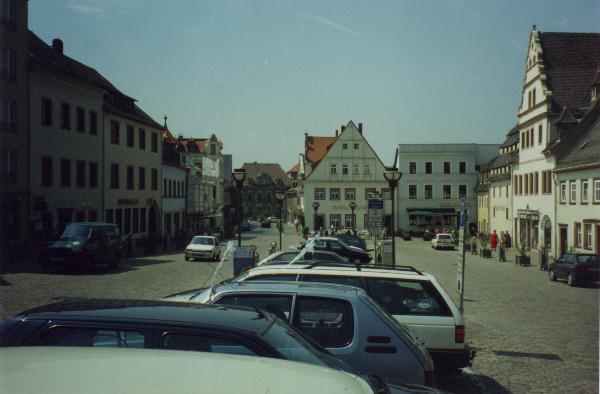
This photo is of the main street/square of Colditz town.
|
|
At present you have to purchase the entry ticket further down the hill from the castle at the town museum. We were told the tour is in English, when actually it is in German, but the guide does answer specific question in English. You only get to see the guard building (which now contains the "escape museum"), the courtyard and the chapel. Entry to any other part of the castle is verboten as it is "too dangerous": yet the place was a functioning old age rest home cum hospital until 2 years ago.
We were able to learn in the town that the castle is owned by the state of Saxony and that their approach to it is casual to say the least. This does however conform to the "ex-communist" approach to tourism that we saw right through East Germany; to use an Americanism 'they just don't get it'. Haphazard would be the best way to describe the attitude. Yet when you buy your tickets for the castle, you are given a VERY flash brochure/book that covers the castles of the whole region and quite likely cost all of the entrance fee by itself! Colditz Castle has got to be one of the most under publicised/under utilised tourist attractions you will ever find.
The town itself is fairly small. What did leave a lasting impression was the attitude of the town's people; you can almost feel the distrust of strangers. One local (who lives just below the castle) took this even further, he made quite sure he blocked our vehicle in when he double parked so that we could not get out. It was obvious that we were about to pull out of our parking place.
The other thing; was the sewers, as we walked up to the castle - they stank!
Colditz and tourism have a long way to go yet.
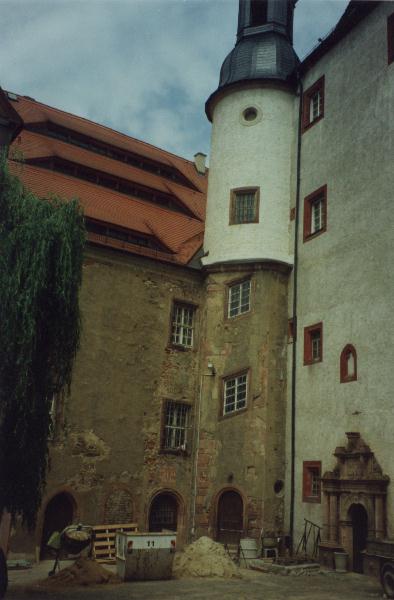
A view through the 2nd archway looking into the main courtyard of the castle.

|
|
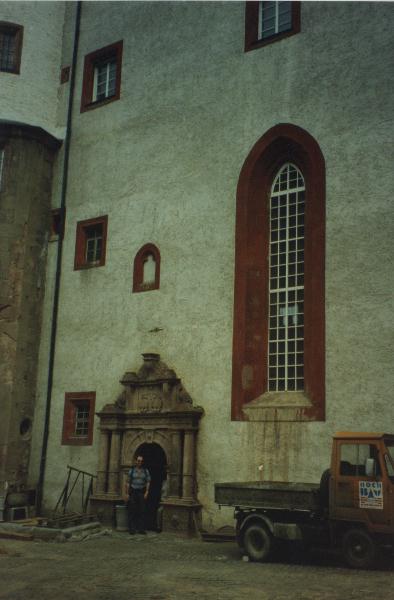
We are now inside the main (prisioner's) courtyard. Colditz is one of those places that really does not lend itself to photography (unless you could do so from an upper floor!). The ornate doorway leads to the chapel, the view generally is of the "British Quarters".
|
|
|
|
Inside the chapel. It is dilapidated but in original condition, which dates back to before WW2 or earlier. I could not get the story straight about the "French Tunnel" which went underneath the floor here. No matter how I interprete the written accounts of the tunnel entrance and exit points it does not line up with what is on display now. One vertical hole seems to be on the wrong side of the room. The stone floor you can see in the photo; was covered by a cavity timber floor with beams crosswise to the tunnel direction. The tunnels had to thus bore through huge hard wood beams rather than dirt and masonary.

|
|
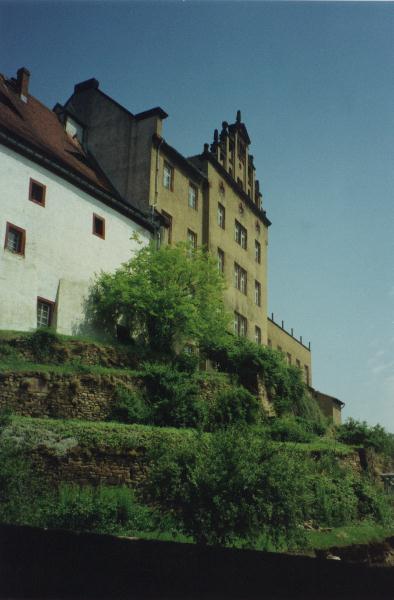
Here we see the terraces that were a noted part of the obstacle course to be negotiated by any escaping prisioner. As you can see in the picture, the castle buildings appear to be more a series of different buildings and styles than one purpose built defensive works that you would see in England or France.
|
|
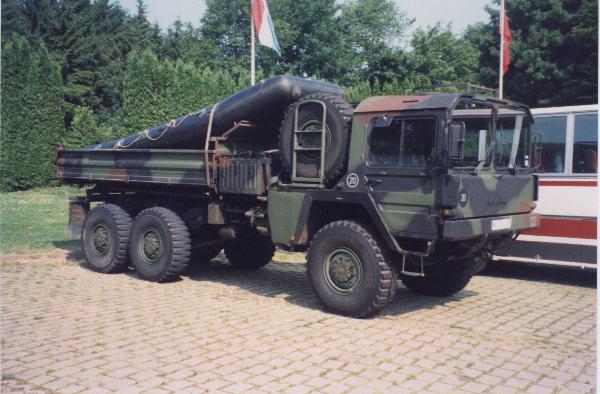
A MAN N 4530 truck.
This photo was actually taken at Hameln; which to us is Hamelin of Pied Piper fame, it is quite out of sequence as it should be before Braunschweig in this story.
MAN 7 ton (payload) version Type MAN N 4530. This is a special version of the standard cargo bed model: it is the rare dumper version. Only 693 of them were built.
|
|
Nuremburg - The Nazi party rally grounds.
We have all seen that film of the huge rallies that happened in Nuremburg, complete with all the banners and searchlights. Well this is the place. Today it has a race track and other sporting facilities and is no longer the huge open space it once was. The photo's below are of the Zepplin Grandstand, the first one is 1936, the second 1967, (when the local authorities blew up the colonade section as they considered it unsafe). The third photo is what you can see today.
It is a sobbering experience to stand on the podium area and visualise what once occured here and what it all led to. This parade ground and grandstand is only a small part of the total party grounds.
The 2 black and white photo's came from a good booklet that is provided as part of the entrance fee to the educational display (Nazi attrocities etc) that is located below and to the rear of the grandstand.

|
|

|
|

|
|
Myself standing at one end of "The Great Road" which is also part of the rally grounds, some road!.

|
|
To continue, click =
Germany 99 part 3 (includes Maginot Line)
 BACK TO INDEX BACK TO INDEX |