
| T A N K S | C A R R I E R S | G U N S | A R M O U R E D C A R S |
Into Germany
After France we headed into Belgium and the Netherlands; as Fran had requested some "tankless" time we didn't visit any military sites in these countries. So the military aspect of the holiday only resumes again once we get to Germany.
The snorkel U-Boat
We headed into north Germany by way of Cuxhaven, and then to Bremerhaven to see the maritime museum and the Type XXI U-Boat that Andreas had told me was there. These U-Boats were equipped with a snorkel system that allowed them to run submerged on there diesel engines, which at the time was quite revolutionary. This particular U-Boat, the Wilhelm Bauer (post war name) had been scuttled under Allied orders when the war finished. 7 years later the Allied attitude to Germany having submarines had radically changed and they were allowed to recover it. Touring through the vessel, you would never know it had been sunk for all that time. Once it was overhauled it then went on to serve for many years before being turned over to the museum. Technically this is U-2540 and it has been returned to its WW2 appearance with (fake) gun turrets.
Well worth a look; however, the tour info throughtout the boat is in German, so the English guide book is advisable.
|
|
On to Braunschwieg
It was then on to visit Andreas and Regina and to make our base at their place for a few days. First destination was the Panzer Musuem at Munster. At this point Andreas will explain where exactly Munster is located as countless numbers of both German and American servicemen, not to mention a few tank enthusiasts too, have ended up at the wrong Munster much to their annoyance. When I had a quick look through my Gernman maps I could locate 7 places with Munster as there name or as part of it.
-------------Here we go--------------
Munster (with simple letter "u", the town of the Panzermuseum). Location: 10° 5' eastern longitude, 52° 59' northern lattitude
Munster is a small town in northern Germany, 70 km south of Hamburg. One part of Munster is "Munsterlager". "Lager" means not the beer, it means "camp" or "barracks". At Munsterlager there are barracks for the troops which are training and exercising on the military training grounds around Munster.
Around Munster there are big military danger zones, where tanks and artillery are shooting with live ammo. Munster is the home of the German tank forces from the beginning until today.
------------Trennung------------
Münster (with Umlaut "ü" or Muenster (ue) if your typewriter has no "ü") Location: 7° 38' eastern longitude, 51° 58' northern lattitude
Münster is a much bigger town, located 50 km north-east of the Ruhrgebiet. (look for Dortmund or Osnabrück nearby on a map?) It is around 200 km (direct air line on the map) south-west of the real Munster with the Panzermuseum. At Münster there are virtually no tanks!
-----------Verstanden?-----------
So, I got chauffeured to Munsterlager by someone who knew which one to go to - it helps! The museum consists of several buildings and is layed out so that your walk the length of the buildings with a row of tanks or exhibits on each side of you. Most of the exhibits are indoors. I never did find where they had their Tiger I hidden.
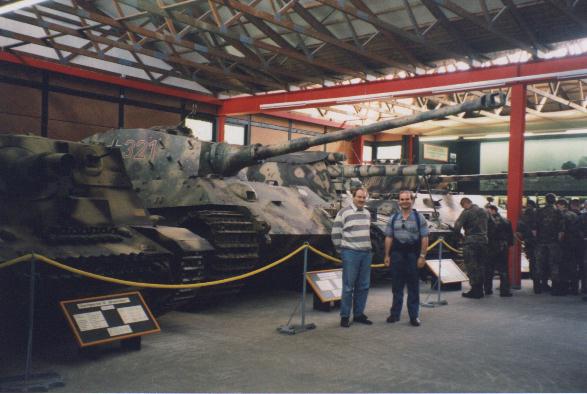
This photo shows Andreas and I in front of a Brummbar (on left) and a King Tiger, in a very nice "woodland" camo scheme, the next vehicle is some sort of self-propelled artillery gun and then a Panther at the back. Very handy to have a german along to translate!
|
|
Some of the shells and missiles on display.

|
|
A better view of both Andreas and the Panther.

|
|
On the left is what appears to be a Panzer III and if memory serves me correctly, the vehicle on the right is a Panzer IV Ausf. F2.
The F2 were known to the British as "Mk4 Specials", there were only about 50 of this model in North Africa but they were armed with a "long 75mm" gun and caused havoc with the opposing British vehicles.You may be able to make out some round objects on boards along the back wall in this shot. These are a collection of helmets, both tank and battle; there is a very large number of them!
At this point I should mention that as we were leaving the museum it was lunchtime and just across the road is a small shop. It has a very German menu and at the time was a bit crowded by a PanzerJäger squad, they seemed to be enjoying the food so we reluctantly decided to chance it. On the menu was Brockwurst (boiled German sausage), Bratwurst and Currywurst (both are fried German sausage), Andreas said we should sample this. I tried all 3 and liked, best of all, the Currywurst, you can have it with Sauerkraut salad which was quite nice and not the culinary disaster us English speakers expect. If you visit the museum have a try of this food to "round out" your German experience.

|
|
The "Inter-German Border
We have all heard of the "Berlin Wall"; what is less well known is that the divide between the 2 Germanies extended across the length of both countries. The actual "wall" only existed in Berlin and in front of houses where the "boundary" passed through or alongside a village.
In this photo you see a preserved section of the border/boundary fence. The fence was made from "the finest Swedish Stainless Steel" expanded mesh, while the wall was from pre-cast concrete. On our left is one of the border markers, these columns marked the "Real Border" whereas the fence/wall was often up to 150 metres inside of East Germany; as you can imagine, a number of people discovered this technicality only after being arrested by the border guards.
The border guards were East Germans not Russians! They were called "Grenztruppen" (Border troops) and were special units of the East German Army. They had orders to shoot anyone who tried to escape from East Germany.
Around 700 people died trying to cross the border, the last one in 1989.

|
|
The border guards had their own private road on the eastern side of the border; this was located close to the "wall", a 5km "verboten" (forbidden) zone existed along the border; entry to this required a special resident pass. There were Soviet troops stationed in East Germany who were housed in their own buildings, within compounds and had no contact with the East German citizens.
In this photo you see a surviving section of the border/boundary road. Nearly all roads in East Germany were built on this pattern, which is a form of cobblestone and believe me, are not pleasant to drive on. They are to a design which was in common use during the pre-WW2 era. Nearly all significant roads have been resurfaced since reunification, but it is still possible to find examples of this style, we did, even in Berlin around Potsdam.

|
|
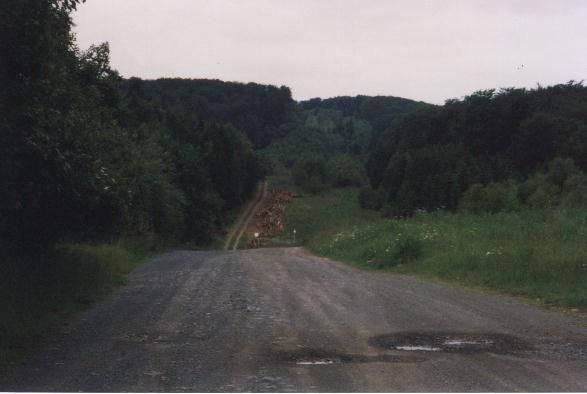
Here we see where the clearing for the border fence used to be. It hasn't taken long for the trees to start taking over what was once there's. The giveaway is the border road in the middle distance.
|
|
No-man's land.
Here we are standing in what was once the mined area between the inner and outer fences. Note that at this particular spot there is an actual wall due to the nearby village. Also note that the viewing area has a handrail around it. There is a sign to say that the area has been cleared of mines but you are advised to remain within the viewing area as the authorities cannot be certain that all the mines were found! Note the observation/guard tower in the background.

|
|
Marienborn.
Westerners are familiar with the name "Checkpoint Charlie" because of the amount of publicity given to it by the Americans. But first you had to get to Berlin itself. There were 3 "corridors" (Autobahns) into Berlin through the Soviet zone which led into the Allied sector of the city. Then there was the actual checkpoints located in the centre of Berlin for access to East Berlin.
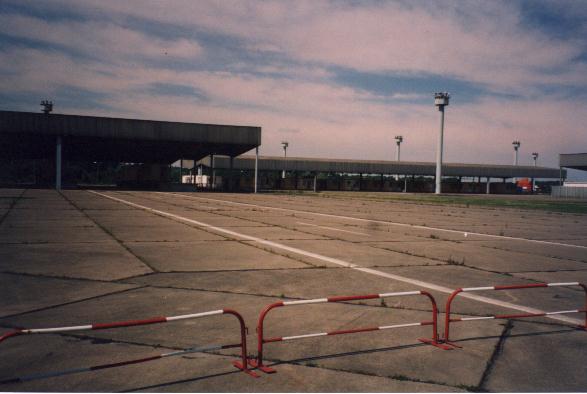
Here you see just a small part of what was once the Helmstedt-Marienborn checkpoint on the inter-German border, from here on you travelled through the Soviet zone and it was not possible (for a westerner) to exit the Autobahn until you entered Berlin unless you had the pass to do so. Nor was it allowed to fraternise with a citizen of the East at any of the roadside rest stops. A man Andreas knows made the mistake of being seen to give an Eastern citizen a Western magazine at one of these; it cost him 7000DM (~AUD $6000) in fines before he was allowed to leave.
Underneath Marienborn is a network of tunnels interconnecting all the booths, buildings and watch towers. As this facility is still "owned" by local government (former communist administration), who don't seem to be all that interested in the tourism potential of this site, access to these only occurs for a few hours on 1 day of the year. From what I am told the line of people last time had to be seen to be believed: BUT only groups of 5 are allowed through; one group at a time - most people missed out.
We were to discover once we moved into East Germany that although the wall is down, the ingrained secrecy outlook from Soviet times is still there. Tourism is a concept with which the East is having difficulty coming to terms, they are getting there, but in a haphazard way.
|
|
Standing all by itself in a corner of Marienborn is this tank "Turret Training unit", the bodywork and wheels appear to be ornamental only; whilst the turret is actually a fully fitted out fake. It is made from steel plate, welded together in what appears to be hand worked segments: but has all the right equipment, gun, hatches, cupola etc., from a real vehicle. It has suffered from vandalism and the weather, but other than not having any radios is surprisingly intact inside.

|
|
German Humour and bananas
Inside one of the check booth buildings is a display of German cartoons and humourous posters to do with the reunification. You really do need someone who can translate for you so that you can appreciate what it is all about. For me, the most memorable part was a large photo poster. On it was a woman of about 30 holding a cucumber which had been peeled half of its lenght the same way you would peel a banana. There are tears rolling down her cheeks.
Andreas explained that Ossies (East German citizens) had not had banana's since before WW2 and thus the younger Ossies had never even seen any, just been told about them by their parents, they were a food of legend. So there is this photo of the woman with the cucumber and the caption underneath it reads "My very first banana".
Such was the culture gap at the time of re-unification.
One of the first things the Ossies escaping to the west did, was ask for a banana.
I have now set the scene for the following story about the Trabant, so that you will understand the reference in it to banana's.The dreaded Trabbi (Trabant).
The opportunity to have a drive of one of the notorious Trabant cars came about whilst we were staying with Andreas. His brother's girlfriend needed a car to get to university and what better than a cheap Trabant.
These vehicles were made from the 1950's right through to the fall of the wall. They were quite a thing in there day, the only trouble being the design was never updated. The eastern philosophy being , why waste effort and money updating a vehicle that has a waiting list time of over 10 years and which the demand far exceeded supply.
(The communist party decreed how many Trabants would be produced in every 5 year plan, the demand and supply figures for the previous 5 year plan were irrelevant to planning of the next 5 year plan).
The party also controlled spare parts supply and could see nothing wrong with locating say, all the brake pads in one city and all the clutch plates hundreds of kilometres away in another. So the Trabant owner also had to have contacts in many places in order to be able to get spares for his vehicle.
So, courtesy of Marion Kirchner, I was able to have a drive of a newly purchased Trabant under the watchful eyes of an "official German vehicle examiner/driver examiner" (Andreas).
The Trabant is somewhat similar to an English Morris 1100 of the same era, but has a 2 stroke motor and a body made of what has been described to me as a cross between cardboard and fibreglass. The column shift is regarded as most curious (though not for me as I learnt to drive a manual gear change on Chryslers and Holdens, which are similar). They are renound for there unreliability due to poor factory workmanship. Most West Germans regard Trabants with as much embarrassment as the English do their own 3 wheel "Reliant Robins".
To give you an idea of the German perspective; one of Andreas' friends has written the story below for me about his Trabant:
From Michael Meier, who collects VW products and owned a Trabant -
Being a car nut, of course I also had to have a Trabant. This was in 1989 before the boarder opened when I got an '84 601s universal, the estate version. It came via Hungaria with a guy who left everything behind and "moved" to Braunschweig. He wanted an Opel (Vauxhall) [as most GDR-people in those days] and to get rid of the Trabbi.
I got it registrated one day before the border opened. The Lady at the plate-shop gave me a big discount with the comment "you don't have too much money now, haven't you?" I agreed. She thought, I was a refugee too.
Very interesting. At first all people were looking at me with "oh, look, another guy who came over from GDR".
When the boarder was open some days later, things changed completely and everybody was flashing (their lights) to say "welcome". I had to keep the windows closed, otherwise they would have thrown Bananas in. (Tat banana thing again!)
Believe it or not.
A month later or so the euphoric time was over. People were, as you wrote, looking away when they realised a Trabbi.
"Another guy who wants to take my job. He should go back to the Ostzone". (Ost = East)
I drove it about half a year as daily transport, and then gave it away because it was dangerous to drive. Nobody could drive behind a Trabant, I was overtaken always and everywhere, there were zillions of really dangerous moments. It took me down to Frankfurt, where I got a Catalyst for it. The journey was not as bad as I expected. I broke down only once, when the ignition switch was at its end. Normal problem.
A friend got me another one for 4 Eastmark in eastern Berlin. (One advantage of owning a car nobody wants is that parts are cheap.)
Andreas took it for going to work one day. The customers were impressed, his Boss asked him if the monthly charge was really that low... He got it nearly burnt, because the fuel lines started leaking, normal problem with a 5 years old Trabbi.
The best trip ever was on christmas eve 1989 when we were first time allowed to enter DDR (the eastern zone = soviet zone) without a Visa. I was on my way home to Wolfsburg, where my parents live. There was enough time to take a deviation via Helmstedt to DDR, going north and back to Wolfsburg.
The Grenztruppen-Polizist realised that I came with a Braunschweig number-plate and passport and asked me, why I am driving a Trabant. I answered that I always wanted a Trabbi just as he always wanted a Golf. Then I asked him, if it would be a problem to take my 2m-radio with me. He gave up, completely unnerved , with the comment "it's christmas today" and I got way.
On my further way, a guy polished his Golf in his driveway, one of 10.000 that were imported as a part of compensation-business. He realised my number-plate and was standing there with an open mouth.
When going back to the golden west the eastern border-police asked me how long I wanted to stay in BRD. I answered, that I lived good there for nearly 33 years then and that there would be no reason not to continue. He gave my passport back and hasn't understood that up to today.
The coffee at the Oebisfelde railway-station-restaurant was 0.87 M. Complete with sugar and milk, otherwise it would have been cheaper. (These days in the east, the prices are as dear as the west, Coffee with sugar and milk would probably cost over $5)
War eine schöne Zeit. (Direct translation = Was a nice time, English equivalent = those were the days.)
In this photo you see Andreas' brother giving final instructions about not bending Marions' "new" car, whilst Regina looks on with much amusement.

|
|
Safely back, even after being driven by "a certain Aussie" (as Andreas refers to me) I am on the left, he is on the right.

|
|
To continue, click =
Germany 99 part 2
 BACK TO INDEX BACK TO INDEX |